Agents
gdb-wui -mcp serves MCP on stdio for an already-running gdb-wui, so an agent can read the binary, drive the debugger and write down what it worked out. Point Claude Code, or any MCP client, at it:
claude mcp add gdb-wui -- gdb-wui -mcp -mcp-annotate -mcp-run
Start gdb-wui as usual first — the bridge joins a session, it does not create one:
mkdir -p /tmp/tour && cp testdata/fixtures/nodebug.c /tmp/tour/
gcc -O0 -no-pie -o /tmp/tour/nodebug /tmp/tour/nodebug.c && strip /tmp/tour/nodebug
./gdb-wui -project /tmp/tour -exe nodebug -ghidra ~/ghidra_12.1.2_PUBLIC
That is the binary in the screenshot below: nodebug.c with no debug info and no symbol table, which is the case an agent is actually useful for. Point it at your own program the same way.
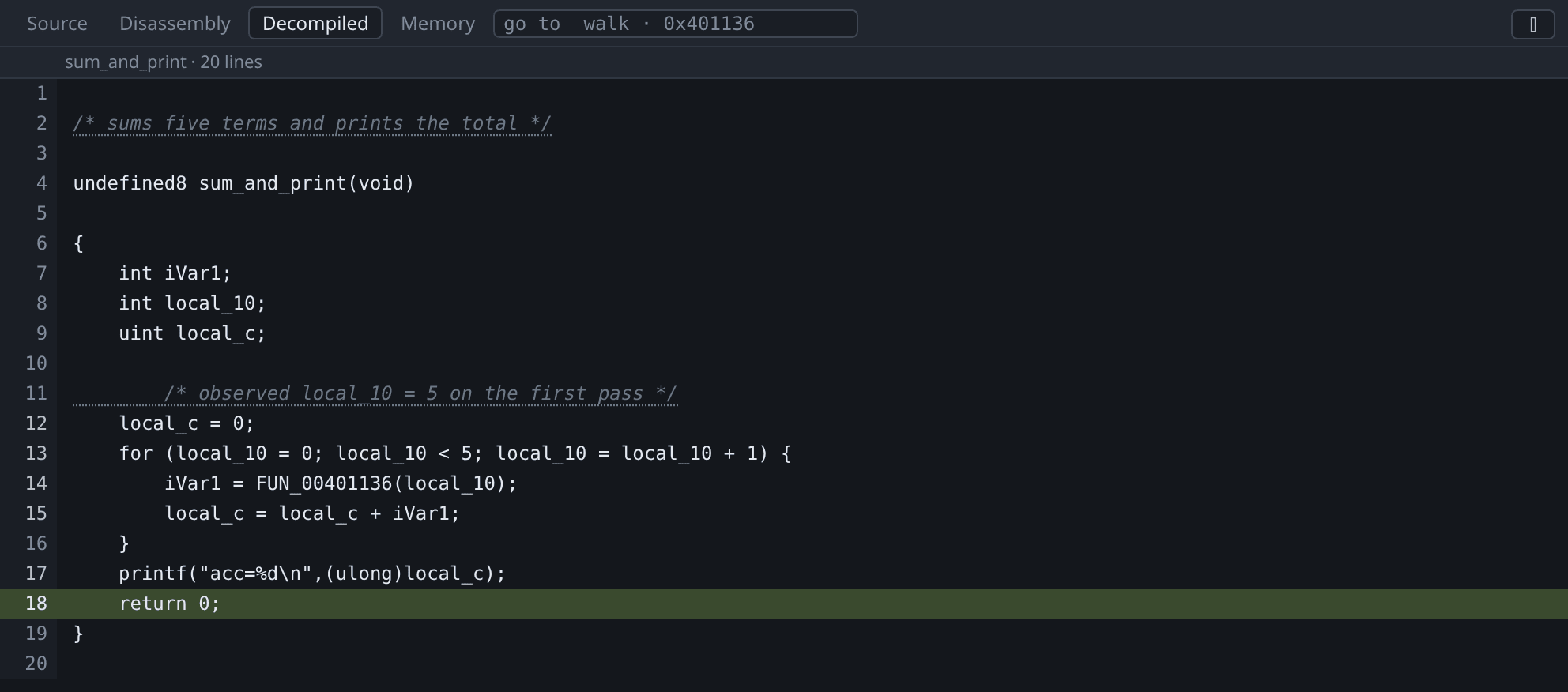
The screenshot above shows live updates to the decompilation made by an agent: the function’s name and both comments, written through the bridge. The pane repainted by itself, as edits are broadcast to open tabs.
Why this needs a running program
An agent can point a decompiler at a binary anywhere. What it cannot usually do is check. Here it can set a breakpoint, run to it, and read what is actually in the variable:
decompile_functionsayslocal_cis auintand gives an expression for it.set_breakpoint,run,evaluate— it holds 84 at this point, which is the running total and not a length.commentsays so, on that line, for next time.
Every step of that is a tool call, and the conclusion outlives the session because it goes into the Ghidra project.
The three permissions
Reading a binary, writing into your Ghidra project and running your program are three different things to agree to, so they are three flags. -mcp alone is read-only.
| flag | what it adds |
|---|---|
-mcp | Decompile, disassemble, read the stack, locals, registers, memory and expressions. Changes nothing. |
-mcp-annotate | Rename, retype and comment, in the decompiler’s database. |
-mcp-run | Set breakpoints; run, step, finish and pause the program. |
A tool you have not permitted is not offered to the model at all, and is refused if it is called anyway.
Four things are absent whatever you pass: writing to the program’s memory, assigning to a variable, writing a register, and the gdb console. The console runs any gdb command, so permitting it would make the other three flags meaningless.
-mcp-runruns your program with your privileges, on the agent’s initiative. That is what a debugger does, and it is why it is a separate flag from reading. Do not pass it for a binary you would not run yourself.
The order to call the tools in
status first: what is loaded, whether the program is stopped, whether the decompiler is ready. Then wait_for_decompiler, because Ghidra takes seconds on a small program and minutes on firmware and can answer nothing until it has finished.
On a stripped binary there is nothing to list — list_symbols is empty, which is the whole reason the rest exists. The way in is the stack: stack, name_addresses to find which frames the decompiler knows, then decompile_function on one of them and the FUN_ names in the recovered C lead to the rest.
The tools that run the program return the stop, not an acknowledgement. run answers with where it stopped and why; there is nothing to poll, and nothing else can be read while the program is running. If a call comes back “still running”, the program is waiting for input or in a loop, and pause stops it.
The tools that write answer with the function decompiled again, for the same reason. An edit is not local to what it touched: a prototype changes how every caller reads, and a type reshapes the body around it — typing a table as an array can merge or retire the very variable that indexes it. So the reply is the new view, and the next edit is built from that rather than from the decompilation before it. An edit naming a variable the function no longer has is refused, and the refusal lists the names it does have.
Reading what an agent wrote
Everything it writes is marked, in gdb-wui and in Ghidra.
- Names and types are recorded as inferred rather than as something you stated — Ghidra’s
ANALYSISsource type, which its own UI shows. The right-click menu says so before you replace one. - Comments are marked with a Ghidra bookmark, so the note is exactly the text that was written and the authorship travels beside it. In the Decompiled tab an agent’s comment is underlined and says so on hover.
Rewriting an agent’s comment yourself takes it over: what is on the page afterwards is yours.
Nothing here is a symbol: a name an agent chose is not one the binary carries, any more than FUN_00401154 is, so the call stack shows both in italics.
Undoing an agent’s edits
Ctrl+Shift+Z undoes one edit. An agent writes in bursts, so consecutive edits by one author form a run, and right-clicking in the Decompiled tab offers Undo the agent’s last N edits — the whole burst, in one step. A run is reversed newest-first through the same path a single undo takes.
Only the most recent run can be undone. Each inverse was worked out against the state its edit left behind, so taking an older one back first would put a name over something later renamed.
How the bridge works
The bridge is a client of the running gdb-wui, not a second way into gdb. It reads the same 0600 run file -print-url reads, mints a login the same way, and joins the same WebSocket your browser is on; every tool is one request from the protocol.
That is not an implementation detail so much as the safety argument. The refusal to write to a project you named with -ghidra-project, the rule that nothing may be read while the program runs, the translation between runtime and link-time addresses, the undo journal, the broadcast that repaints open tabs — an agent gets all of it because there is no other way in.
What it does not do
- It brings no model. gdb-wui makes no network requests of its own and holds no API key; whatever you point at it does that, under your own account.
- It does not enumerate Ghidra’s functions.
list_symbolsreads the binary’s symbol table, which a stripped file does not have. An agent explores from the stack and from call targets in the recovered C. - It does not edit struct fields, for the same reason renaming does not.
- It does not run without a server. Start gdb-wui first; the bridge exits saying so if there is nothing to join. With several running,
-addrchooses.